Forests are vital components of the Earth system, supporting biodiversity, regulating biogeochemical cycles, and sustaining ecosystem productivity. Nitrogen (N) is an essential nutrient for plant growth, and the N cycle plays a central role in determining forest productivity, stand structure, and species diversity. Increasing atmospheric inputs of reactive N from human activities can therefore alter forest N cycling and its associated ecological functions.
The forest canopy is a critical interface for material exchange between the atmosphere and terrestrial ecosystems, and a key pathway through which atmospheric substances are transferred to forest soils. Although research established as early as the 1980s that atmospheric N deposition measured in open field does not adequately represent the N input to forest soils (Lindberg et al., 1986, Science, 231: 141–145), quantitatively constraining N exchange between precipitation and forest canopies has remained a major challenge. This limitation complicates assessments of the ecological effects of anthropogenic reactive N inputs to forest ecosystems.
In recent years, Professor Liu Xue-Yan’s research team has developed an isotope-based process model and integrated existing observational data to quantify the relative flux contributions associated with canopy-mediated N exchange. The framework distinguishes between the loss of N from precipitation through canopy retention and uptake (Loss) and the gain of N in throughfall from canopy-associated processes, including mineralization and nitrification, as well as the wash-off of particulate N deposited on canopy surfaces (Gain). The team’s findings on nitrate (NO3−) were reported in 2023 (Liu et al., 2023, Global Biogeochemical Cycles, 37: e2023GB007920).
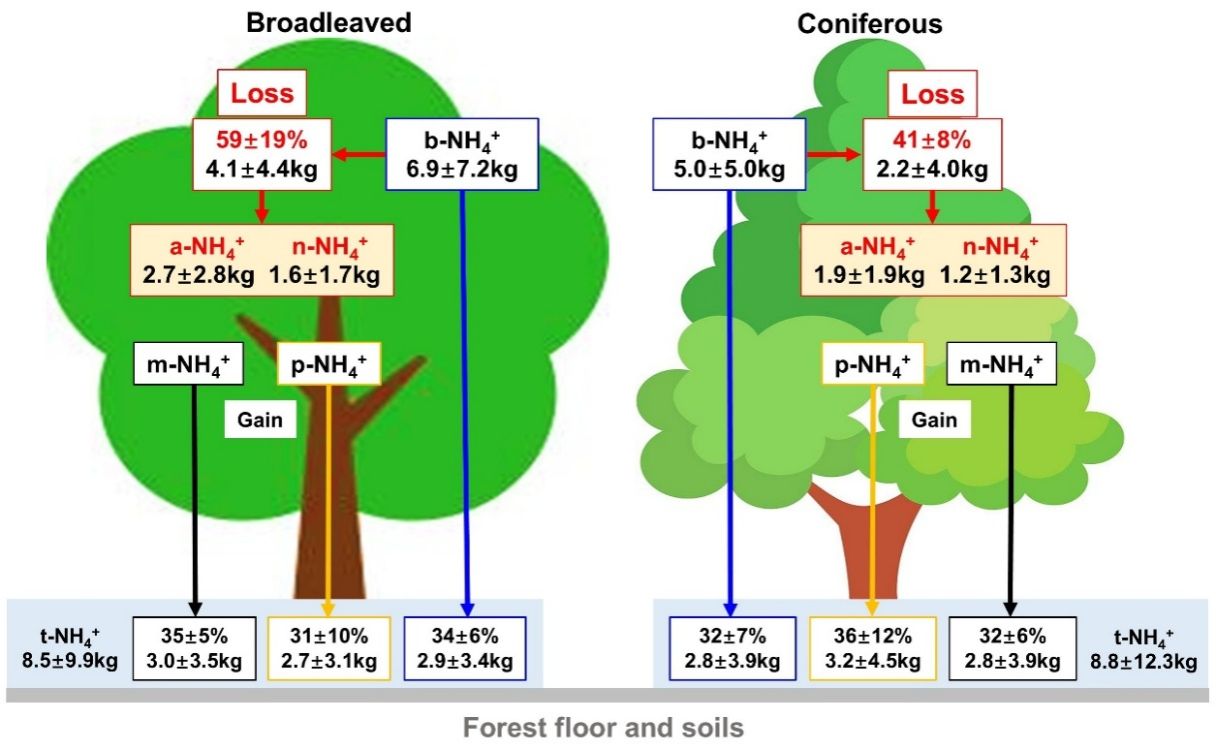
Fig. Proportions and fluxes of major processes in precipitation–canopy NH4+ exchange
(b-NH4+: bulk precipitation NH4+ in open field, p-NH4+: canopy particulate NH4+, m-NH4+: NH4+ from canopy mineralization, t-NH4+: throughfall NH4+, a-NH4+: canopy NH4+ uptake, n-NH4+: canopy NH4+ nitrification)
In their latest study, the team extended this approach to ammonium (NH4+) and obtained two key findings. First, canopy-derived NH4+ inputs to throughfall (Gain) generally exceeded NH4+ losses from precipitation during canopy passage (Loss; Fig.), indicating that estimates based solely on precipitation measurements may underestimate NH4+ inputs to forest soils when canopy-mediated N gains are not accounted for. Second, both NH4+ Gain and Loss differed between broadleaf and coniferous forests (Fig.), highlighting the importance of forest type in regulating precipitation–canopy N exchange. However, the underlying physiological and ecological mechanisms, as well as canopy responses to increasing atmospheric NH4+ deposition, remain poorly understood. The extent to which NH4+ removed from precipitation is subsequently taken up by foliage is also unresolved. To address these knowledge gaps, the team is conducting field-based observations and developing a leaf-tissue free NH4+ indicator to further investigate canopy NH4+ uptake.
This study provides a new methodological framework for investigating N cycling at the land–atmosphere interface and offers insights relevant to forest ecosystem assessment and environmental management. The paper was published in October 2026 in Global Biogeochemical Cycles, a journal of the American Geophysical Union (AGU). Ke-Tong Yang, a doctoral student at the School of Earth System Science, Tianjin University, is the first author, and Xue-Tan Liu is the corresponding author. The research was supported by the National Natural Science Foundation of China (Grant Nos. 42125301 and 42330505), among other funding sources.
Paper information:Ke-Tong Yang, Xue-Yan Liu*. Throughfall gained more ammonium from particulates and mineralization than precipitation ammonium retention in forest canopy. Global Biogeochemical Cycles, 2026, 40, e2025GB009042. https://doi.org/10.1029/2025GB009042