Recently, Associate Professor Dengkai Chi from the School of Earth-System Science, in collaboration with research teams in China and abroad, has made important progress in the field of urban green space exposure and child health. The study provides large-scale, cross-national longitudinal epidemiological evidence linking urban tree canopy fragmentation to mortality risk among children under five and further develops a counterfactual assessment approach to quantify the potential health benefits of optimizing the spatial configuration of urban tree canopy.
The findings were published in Proceedings of the National Academy of Sciences of the United States of America (PNAS) under the title “Urban tree canopy fragmentation and child mortality in low- and middle-income countries.” Dengkai Chi is the first and corresponding author of the paper. The study was conducted with guidance from Academician Congqiang Liu of Tianjin University.
From “How Much Tree Canopy?” to “How Fragmented Is the Tree Canopy?”
Rapid urbanization not only reduces the overall extent of urban tree canopy but can also divide formerly continuous canopy into smaller and more isolated patches, resulting in tree canopy fragmentation. Compared with continuous and aggregated tree canopy, fragmented canopy may weaken ecosystem services such as cooling and air pollution mitigation. It may also affect human health by altering biological habitats and increasing spatial contact between humans and disease vectors.
Children are particularly vulnerable to environmental harms such as extreme heat, air pollution, and infectious diseases. The potential health impacts of tree canopy fragmentation on children therefore warrant particular attention. However, previous research on green space and child health has predominantly focused on measures of green space quantity, such as vegetation indices, green space coverage, and tree density, with considerably less attention paid to how the same amount of green space is spatially distributed. In particular, longitudinal epidemiological evidence linking green space fragmentation to child mortality has been scarce.
Establishing Large-Scale, Cross-National Longitudinal Evidence Linking Tree Canopy Fragmentation to Child Mortality
The research team integrated global high-resolution land-cover data with child health data from the Demographic and Health Surveys (DHS) to conduct a longitudinal study involving 420,244 children under five years of age across 57 low- and middle-income countries.
The researchers quantified the proportion of tree canopy cover (PLAND) within a 2-km radius of each residential location and used the Aggregation Index (AI) to characterize the spatial fragmentation of tree canopy. A lower AI indicates a more fragmented tree canopy landscape.
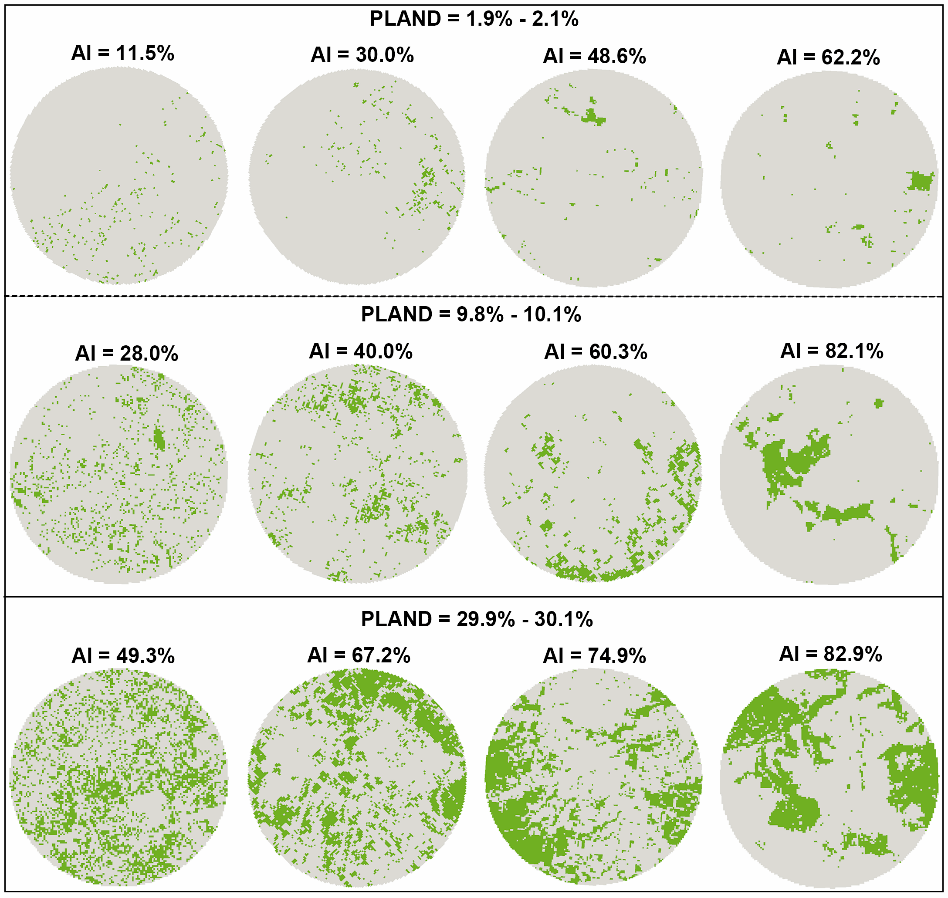
Figure 1. Tree canopy cover (PLAND) and tree canopy aggregation (AI) across urban residential areas. The buffer radius was 2 km.
A key challenge in accurately identifying the health associations of tree canopy fragmentation is the strong correlation between the amount and spatial configuration of tree canopy. In general, areas with greater tree canopy cover also tend to have more spatially aggregated canopy. Without separating these two dimensions, it is difficult to determine whether the observed health associations are attributable to having more trees or to having a more continuous and aggregated canopy.
To address this challenge, the research team developed a spatial aggregation metric independent of tree canopy cover (AIres), thereby disentangling tree canopy amount from its spatial configuration. This approach enabled the researchers to compare the relationship between different levels of tree canopy fragmentation and child mortality risk while holding tree canopy cover constant.
The results showed a nonlinear relationship between tree canopy cover and child mortality risk, with increases in tree canopy at low to moderate levels of coverage associated with lower mortality risk. More importantly, after separating the influence of tree canopy amount, less fragmented and more spatially aggregated and continuous tree canopy remained independently associated with lower child mortality risk. At the same level of tree canopy cover, each one-percentage-point increase in tree canopy spatial adjacency was associated with an approximately 0.17% lower mortality risk (hazard ratio: 0.9983; 95% CI: 0.9972–0.9995).
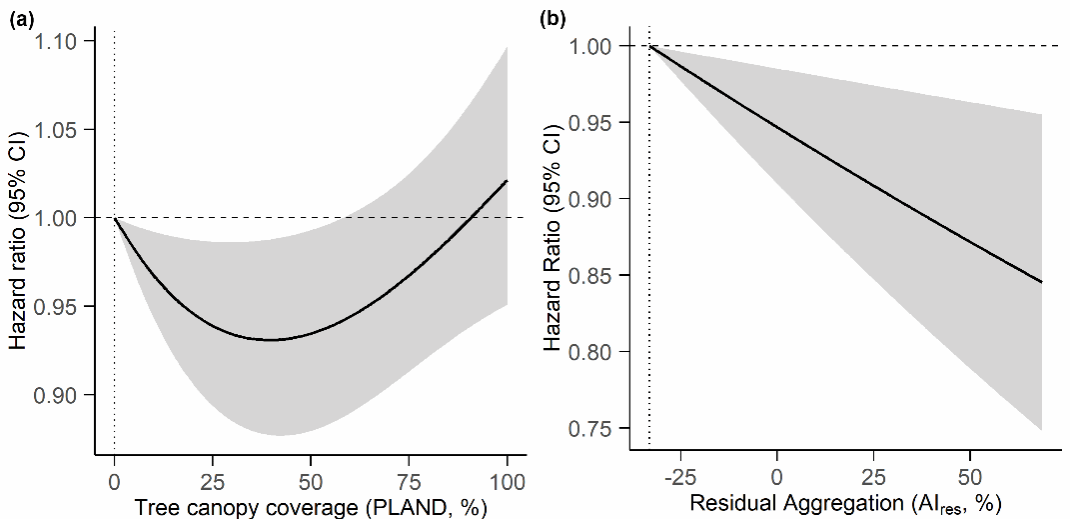
Figure 2. Associations of tree canopy cover (PLAND) and residualized tree canopy aggregation (AIres) with child mortality risk.
Developing a New Approach to Quantify the Potential Health Benefits of Optimizing Tree Canopy Configuration
Building on the longitudinal findings, the study further addressed a question of direct relevance to urban planning: How much potential health benefit could be achieved by optimizing the spatial configuration of tree canopy? Answering this question represents a critical step toward translating research on green space configuration from epidemiological associations into planning practice.
However, because the amount and spatial configuration of green space are strongly coupled, conventional approaches make it difficult to independently quantify the health benefits attributable to configuration optimization. To address this challenge, the research team developed a two-lever counterfactual health impact assessment framework integrating tree canopy expansion and spatial configuration optimization. The framework first quantified the potential health benefits associated with increasing tree canopy cover. It then built on the approach described above for disentangling canopy amount from spatial configuration and explicitly accounted for the empirical relationship between tree canopy cover and spatial aggregation. This enabled the construction of feasible configuration-optimization scenarios at a given level of canopy cover and the quantification of the additional potential health benefits associated with reducing tree canopy fragmentation. In this way, “how much tree canopy to provide” and “how to spatially configure it” were incorporated into the health impact assessment as two distinct and quantifiable dimensions.
The framework was further applied to urban and peri-urban areas across 98 low- and middle-income countries. The analysis identified the West Sudanian Savanna, eastern Punjab in Pakistan, and the Ganges–Brahmaputra Delta in Bangladesh as priority regions, where increasing tree canopy cover or reducing canopy fragmentation was associated with the greatest potential reductions in mortality burden. The study provides a new quantitative approach and scientific basis for optimizing urban greening under constraints on land and greening resources, for example, by connecting isolated tree canopy patches and improving the continuity of street trees to reduce canopy fragmentation and potentially enhance health benefits.
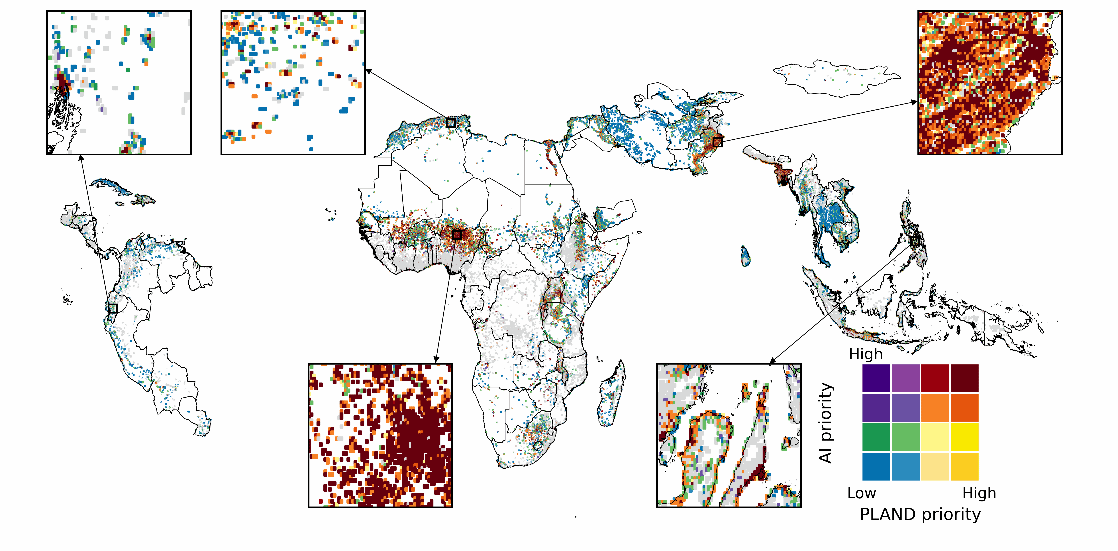
Figure 3. Priority map of the potential reductions in mortality burden associated with increasing tree canopy cover (PLAND) and optimizing tree canopy aggregation (AI). Red areas indicate regions with greater potential for mortality burden reduction through tree canopy optimization.
This study was conducted through collaboration among researchers from Tianjin University, the Singapore-ETH Centre, Tsinghua University, École Polytechnique Fédérale de Lausanne (EPFL), the Bioeconomy Science Institute of New Zealand, the Commonwealth Scientific and Industrial Research Organisation (CSIRO), the University of Melbourne, the University of Macau, and the National University of Singapore. It forms part of the research team’s broader program on the spatial configuration of urban green space and population health, further extending both the populations studied and the methodological approaches used to evaluate the health implications of green space configuration.
For further details, please refer to the links below.
Chi, D., Richards, D., Manoli, G., Yang, J., Ji, J. S., Zhang, Y., Lin, B., Hahs, A., Liu, C., Zhu, Y., Qiu, Y., Wang, J., Burlando, P., Fatichi, S., & Tan, P. Y. (2026). Urban tree canopy fragmentation and child mortality in low- and middle-income countries. Proceedings of the National Academy of Sciences, 123(34), e2606669123. https://doi.org/10.1073/pnas.2606669123
Chi, D., Manoli, G., Lin, B., Aerts, R., Yang, J., Hahs, A., Richards, D., Meili, N., Zhu, Y., Qiu, Y., Wang, J., Burlando, P., Fatichi, S., & Tan, P. Y. (2025). Residential tree canopy configuration and mortality in 6 million Swiss adults: A longitudinal study. The Lancet Planetary Health, 9(3), e186–e195. https://doi.org/10.1016/S2542-5196(25)00022-1
Chi, D., Manoli, G., Yang, J., Richards, D., Hahs, A., Lin, B., McDonnell, M. J., Zhang, Y., Zhu, Y., Qiu, Y., Wang, J., Zheng, X., Burlando, P., Fatichi, S., & Tan, P. Y. (2026). Tree canopy configuration and Swiss adult mortality at the municipal level: A nationwide ecological study. Environment International, 209, 110188. https://doi.org/10.1016/j.envint.2026.110188