Inland waters (e.g., streams, rivers, lakes, and reservoirs) are crucial components in the global carbon cycle. They actively mediate carbon transport and transformation connecting terrestrial, atmospheric, and oceanic ecosystems through three primary aquatic pathways (i.e., gaseous emissions, carbon burial in sediments, and downstream export). Nevertheless, the regional patterns of aquatic carbon transfer remain poorly quantified, and their impacts on the terrestrial carbon budget remain unclear. The research teams from the School of Earth System Science at Tianjin University and the Department of Geography at the University of Hong Kong have collaborated on this work. They mainly focused on the Wujiang River basin (WRB), a typical karst catchment in southwestern China, and extended the analysis to the national scale to quantify regional aquatic carbon fluxes and their influence on landscape carbon balance.
Located in the center of the Southeast Asian Karst Region, the largest karst area in the world, the WRB is characterized by intensive carbonate weathering with an extremely fragile ecological environment and extensive cascade reservoirs. These features make it an ideal natural laboratory for examining the coupling of terrestrial and aquatic carbon cycles. By integrating the three primary pathways of aquatic carbon export into the terrestrial-aquatic carbon assessment, the assessment reports a net landscape carbon sink of 12.0–16.1 Tg C yr−1 in the WRB during the period of 2000–2017, with the aquatic carbon export counteracting 10.6%–14.6% of the terrestrial carbon sink. Downstream carbon export contributed 61.8%–82.1% to the aquatic carbon export with approximately 72% occurring during the wet season, due largely to enhanced rock weathering and allochthonous carbon supply under severe soil erosion in this karst region. Meanwhile, the aquatic carbon export exhibited a discernible increasing trend, indicating that dam construction and ecological restoration have profoundly altered the carbon biogeochemical processes and terrestrial-aquatic carbon transfer dynamics.
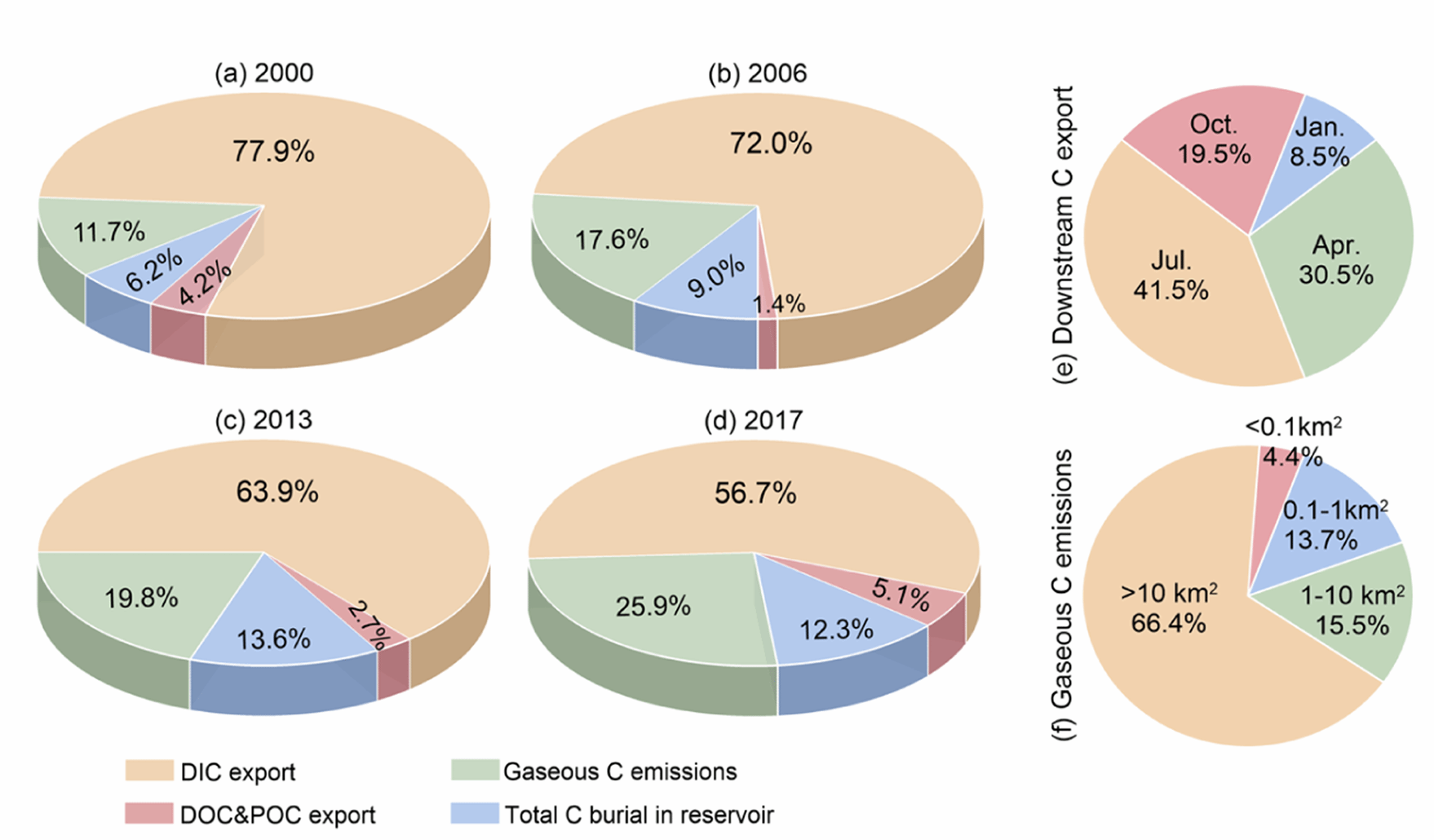
Fig. 1. Relative contribution of the three major pathways of aquatic C export, including gaseous CO2 and CH4 emissions, C burial in reservoirs, and downstream export (DIC, DOC, and POC) during the years (a) 2000, (b) 2006, (c) 2013, and (d) 2017. (e) Seasonal variations of downstream C export in 2017. (f) Proportion of gaseous C emissions from different water surface size classes (< 0.1 km2, 0-0.1 km2, 1-10 km2, and > 10 km2) in 2017.
For the national scale, we quantified the three primary aquatic carbon fluxes and evaluated their implications for China's terrestrial carbon budget. We showed that the total aquatic carbon output flux was 165 ± 20 Tg C yr−1, counteracting 29% of China's terrestrial net ecosystem productivity (NEP). Carbon dioxide emissions from river networks dominated the aquatic carbon transfer, accounting for 52% ± 13% of China’s aquatic carbon output flux. Carbon burial in reservoirs represented a significant anthropogenic redistribution of terrestrial carbon, equivalent to 46% ± 8% of the downstream carbon export across China. Specifically, the net landscape carbon balance (NLCB) in low-productivity regions was sensitive to aquatic carbon transfer, whereas terrestrial ecosystem productivity exerted the dominant control in high-productivity ecosystems. Our findings elucidate the spatial patterns and regulatory mechanisms governing aquatic carbon transfer across China, establishing a robust framework to refine regional carbon balance assessments and inform targeted climate management strategies.
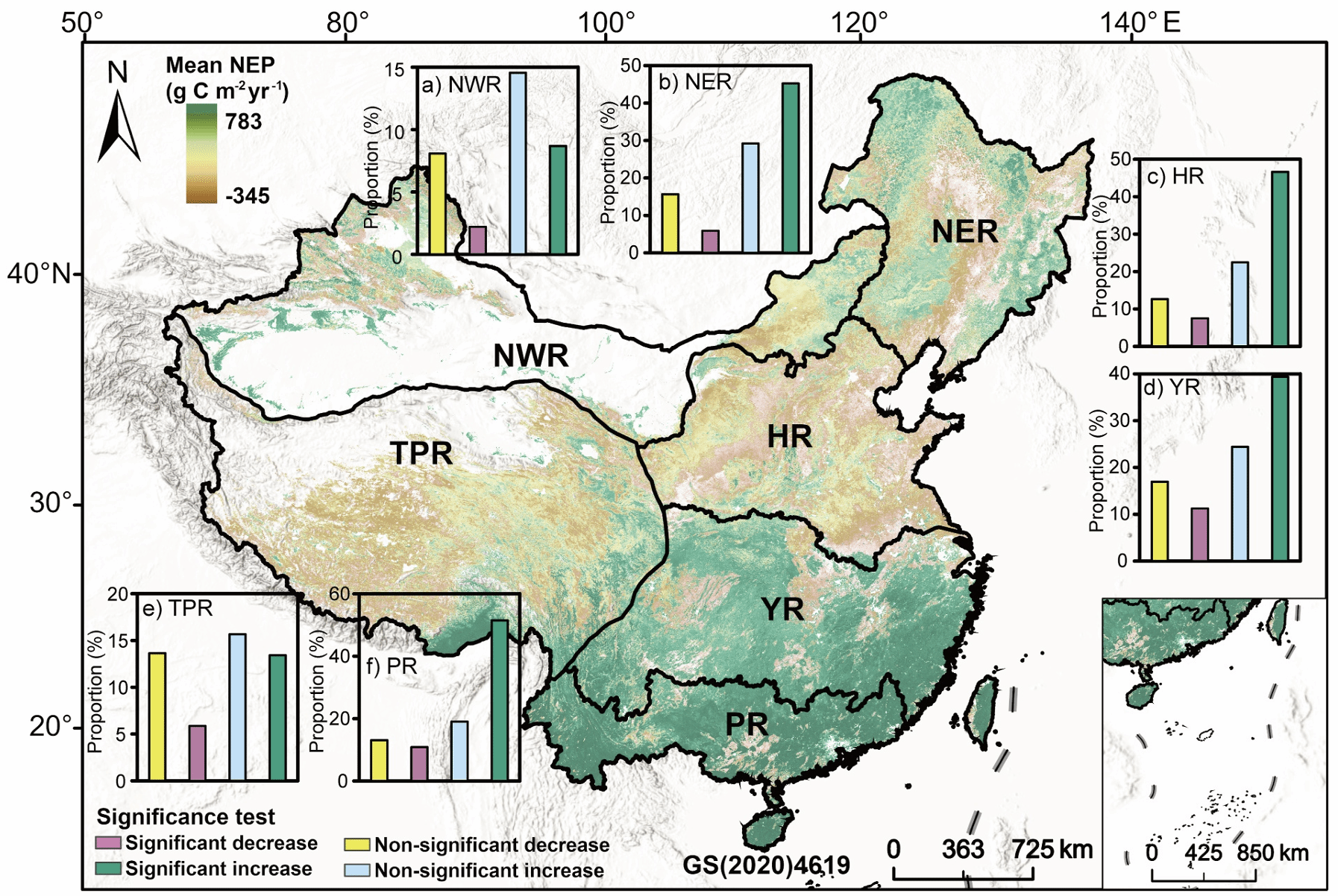
Fig. 2. Spatial variation of mean terrestrial net ecosystem productivity (NEP) across China during the period 2000–2020. The bar charts (a-f) represent the proportion of each region’s land area with different terrestrial NEP changes.
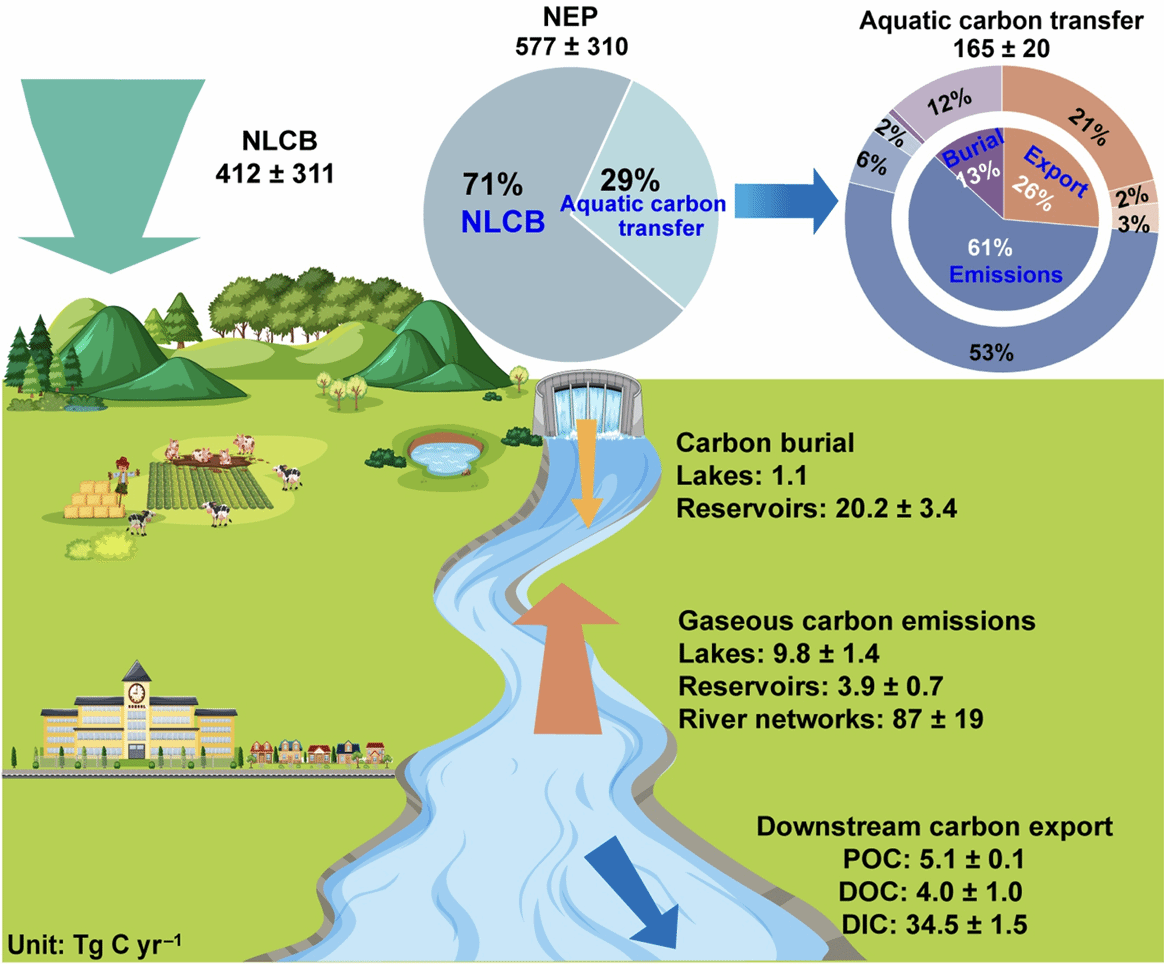
Fig. 3. The net landscape carbon balance (NLCB) of China.
1.Reference:
The first author of these two works is Yongmei Hou, a doctoral student at the School of Earth System Science, Tianjin University. Professor Si-liang Li of Tianjin University and Professor Lishan Ran of the University of Hong Kong are the co-corresponding authors.
Yongmei Hou, Si-Liang Li*, Fu-Jun Yue, Shuai Chen, Xiaolong Liu, and Lishan Ran*. 2025. Carbon transfer from land to fluvial networks in a typical karst river-reservoir system, Water Research, 271: 122899.
Yongmei Hou, Si-Liang Li*, Hang Wen, Sen Xu, Yuxin Li, Shuai Chen, Fu-Jun Yue, Xiaolong Liu, and Lishan Ran*. 2026. Regional patterns and regulatory mechanisms of aquatic carbon transfer in China, Global Biogeochemical Cycles, 40: e2025GB009017.
2.Acknowledgement:
These works were funded by the National Natural Science Foundation of China, the Key Technologies Research and Development Program of China, and the Research Grants Council of Hong Kong. We acknowledge the data provided by the "National Earth System Science Data Center" (https://www.geodata.cn).