Organosulfur compounds are important constituents of atmospheric aerosols and play a crucial role in radiative forcing, global climate regulation and human health owing to their hygroscopicity, optical properties, and potential toxicity. Although the formation mechanisms of atmospheric organosulfur compounds have been extensively investigated, previous studies have mainly focused on reactions occurring in the gas phase or in bulk aqueous solutions. Micrometer-sized atmospheric droplets, including cloud droplets, fog droplets, and wet aerosols, provide unique physicochemical environments distinct from those of bulk aqueous solutions. These microdroplets can act as natural microreactors and may provide previously unrecognized reaction sites for the conversion of inorganic sulfur into organosulfur compounds.
Recently, the research team led by Prof. Pingqing Fu investigated reactions between sodium sulfite (Na2SO3) and several representative oxygenated volatile organic compounds (OVOCs). Microdroplets were generated by pneumatic nebulization, and the reaction products were detected in real time using an LTQ Orbitrap Velos mass spectrometer. The results showed that inorganic S(IV) species can rapidly react with OVOCs at the air-water interface of microdroplets, spontaneously producing organosulfur compounds on a timescale of approximately 220 μs (Figure 1). Remarkably, this process occurred without catalysts, external potential or radiation. These findings point to a previously overlooked interfacial pathway for atmospheric organosulfur formation and offer a new perspective on the potential sources of these compounds.
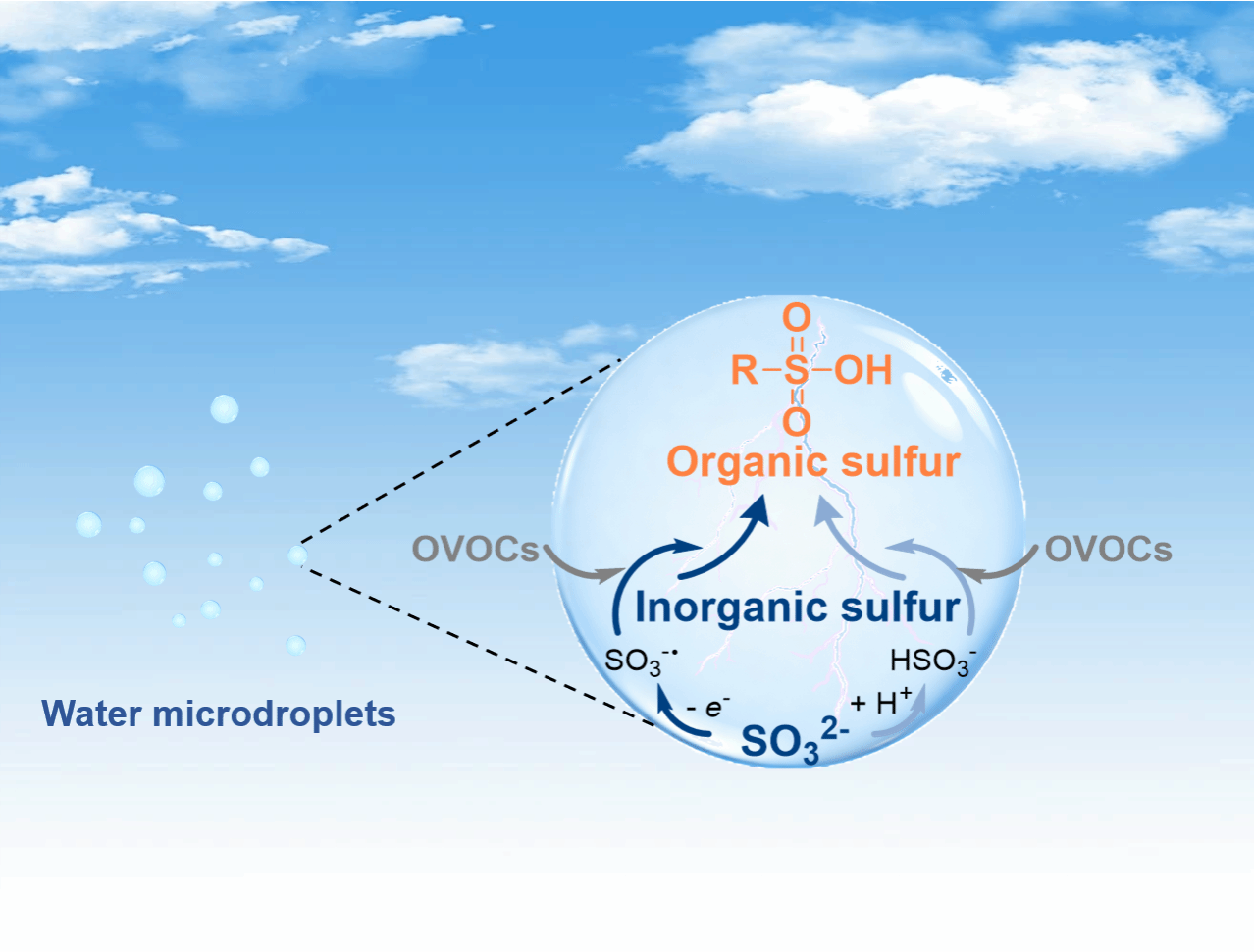
Figure 1. Rapid spontaneous generation of organosulfur from inorganic sulfur in atmospheric microdroplets
To probe the behavior of inorganic sulfur at the microdroplet interface, the researchers first pneumatically nebulized an aqueous Na2SO3 solution into microdroplets and analyzed products in real time using an LTQ Orbitrap Velos high-resolution mass spectrometer. The SO3-• radical was detected, together with the further oxidation products HSO4- and SO4-•, indicating that SO32- can undergo one-electron oxidation within microdroplets to form SO3-• and subsequently be further oxidized toward S(VI) species. The result of pressure-dependent experiments showed that the SO3-• signal increased with nebulizing-gas pressure. Previous studies indicate that higher gas pressure produces smaller droplets with greater surface curvature, which may strengthen the interfacial electric field. This trend is consistent with a role for interfacial electric fields in promoting sulfite oxidation.
Building on these observations, the team selected four atmospherically relevant OVOCs, including glyoxal, α-pinene oxide, methacrolein, and 3-methyl-2-butenal, and individually mixed them with Na2SO3 before pneumatic nebulization. These experiments were designed to investigate reactions between inorganic S(IV) and OVOCs in microdroplets. Corresponding organosulfur products were detected in all four reaction systems, and additional oxygenated organosulfur species formed through further oxidation were observed in some systems (Figure 2). The formation of these organosulfur products was further supported by tandem mass spectrometry, attenuated total reflectance Fourier-transform infrared spectroscopy (ATR-FTIR), and ultra-performance liquid chromatography coupled with quadrupole time-of-flight mass spectrometry (UPLC-Q-TOF MS).
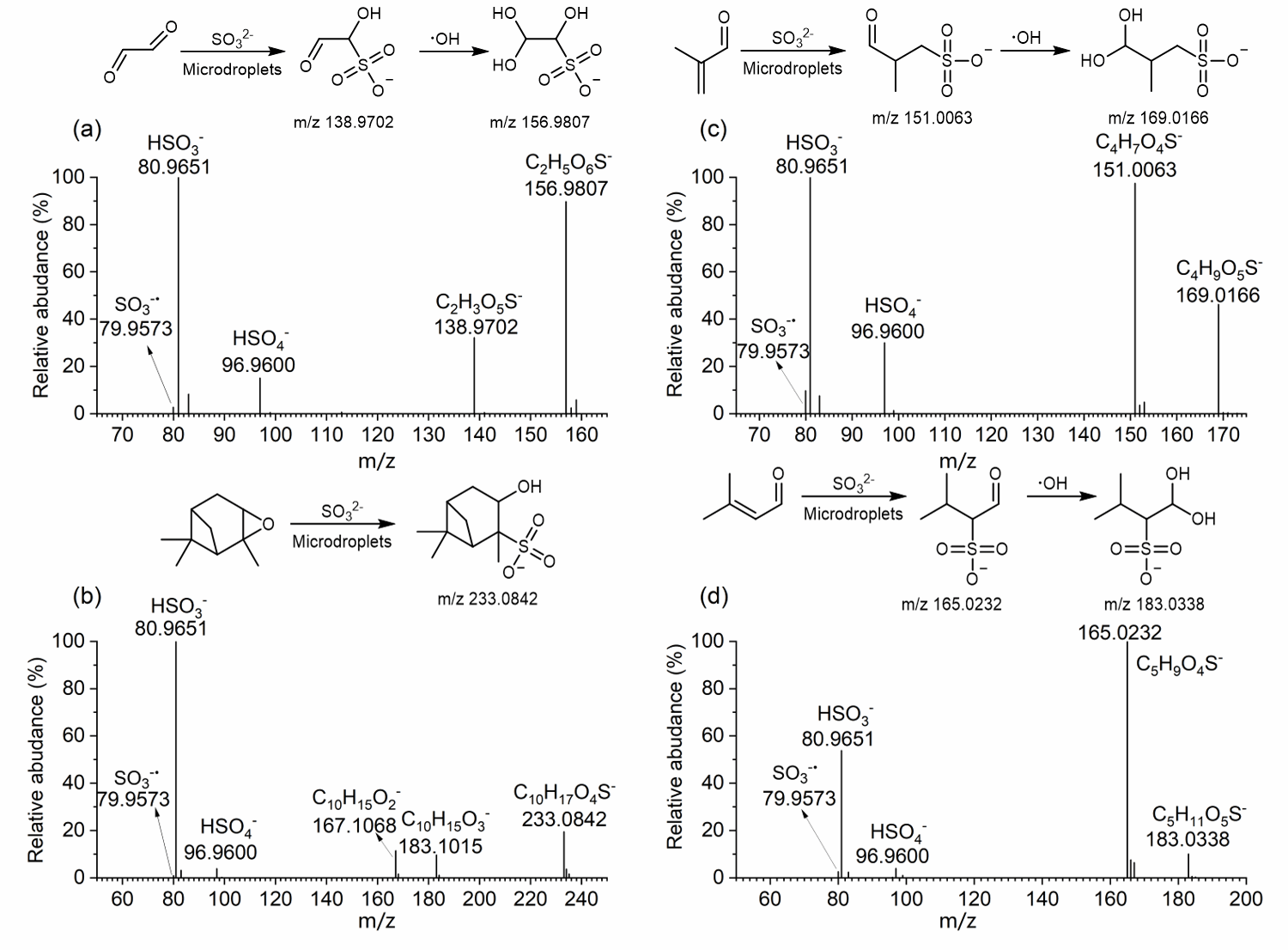
Figure 2. Typical mass spectra of a mixed solution of Na2SO3 and four representative oxygenated volatile organic compounds (OVOCs) sprayed into microdroplets obtained by LTQ Orbitrap Velos.
Based on the structures of the detected products, the researchers proposed two major reaction pathways for the transformation of inorganic sulfur into organosulfur compounds. The first pathway involves HSO3--mediated nucleophilic addition. For carbonyl-containing OVOCs, HSO3- undergoes nucleophilic addition to the C=O bond, leading to the formation of a new C-S bond. In the case of α-pinene oxide, acid-catalyzed ring opening or isomerization can occur in the interfacial environment, followed by reaction with HSO3-. The second pathway involves SO3-•-mediated radical addition. SO3-•, generated through one-electron oxidation of SO32-, can add to the C=C bonds of unsaturated OVOCs such as methacrolein and 3-methyl-2-butenal. Subsequent hydrogen transfer leads to the formation of stable organosulfur products.
To elucidate the mechanism underlying these ultrafast reactions, the team combined quantum chemical calculations with metadynamics simulations based on Born-Oppenheimer molecular dynamics (BOMD) to investigate the reaction processes occurring at the microdroplet interface. The calculations showed that, compared with corresponding reactions in the bulk phase, the activation free-energy barriers of the reactions were substantially lower at the air-water interface of microdroplets. Specifically, the activation free-energy barrier for the nucleophilic addition of HSO3- to the carbonyl group of glyoxal was reduced by 7.45 kcal·mol-1, whereas that for the radical addition of SO3-• to the C=C bond of methacrolein was reduced by 5.56 kcal·mol-1. These results indicate that the unique behavior of interfacial water molecules, together with the strong electric field at the microdroplet interface, creates a more favorable environment for the formation of new C-S bonds.
To further evaluate the potential atmospheric relevance of this reaction pathway, the researchers analyzed atmospheric aerosol samples collected at an urban site in Tianjin and the Shanghuang station in Zhejiang Province. Using Fourier transform ion cyclotron resonance mass spectrometry (FT-ICR MS), the researchers detected organosulfur species at both sites with accurate masses matching those of the laboratory-generated products (Figure 3). Tandem mass spectrometric analysis of the Tianjin samples further revealed characteristic fragment ions consistent with those of the laboratory products, suggesting similar molecular structures. Together, the laboratory experiments, theoretical calculations, and field observations support the potential atmospheric relevance of this pathway and suggest that microdroplet interfacial processes may represent a previously overlooked step in the atmospheric transformation of inorganic sulfur into organosulfur compounds.

Figure 3. Detection of organosulfur compounds in atmospheric aerosols.
The study, entitled “Rapid spontaneous generation of organosulfur from inorganic sulfur in atmospheric microdroplets”, was recently published in Nature Communications.
Article information:Huixia Han, Dongmei Zhang*, Zegang Dong, Jiaqi Wang, Shuang Chen, Junjun Deng, Libin Wu, Wei Hu, Mingjin Tang, Bo Long, Jialei Zhu, Cong-Qiang Liu, Pingqing Fu* (2026) Rapid spontaneous generation of organosulfur from inorganic sulfur in atmospheric microdroplets. Nature Communications. https://doi.org/10.1038/s41467-026-77473-5.