Mercury (Hg) is a persistent pollutant with the capacity for global transport and long-term ecological risks. Gaseous elemental mercury (GEM) is the dominant form of atmospheric mercury and can be transported on regional to global scales. With the implementation of the Minamata Convention on Mercury and the continued advancement of air pollution control policies in China, accurately evaluating the effects of anthropogenic mercury emission reductions on urban atmospheric mercury cycling has become an important scientific issue in atmospheric mercury research and environmental management. However, urban atmospheric mercury is influenced by multiple processes, including local emissions, regional transport, and surface re-emissions. Concentration measurements alone are therefore insufficient to determine changes in source structure and the mechanisms driving these changes. Stable mercury isotopes provide a powerful tool for identifying atmospheric mercury sources and key atmospheric processes.
To address this issue, the Isotope Frontier Science Center at the School of Earth System Science, Tianjin University, conducted long-term observations of atmospheric mercury GEM concentrations and isotopic compositions in urban Tianjin from 2018 to 2025. The study covered three distinct stages: the pre-control period in 2018, the COVID-19 control period from 2021 to 2022, and the post-pandemic period of intensified emission reductions from 2024 to 2025. By integrating observations from additional urban sites, including Tianjin Binhai, Tangshan and Chengde in Hebei Province, Jingzhou in Hubei Province, and Karachi in Pakistan, the study systematically evaluated changes in the source structure of urban atmospheric mercury in China.
The results showed that GEM concentrations in urban Tianjin declined sharply from high levels in 2018 to values close to the regional background during the COVID-19 control period, with no obvious rebound after the recovery of socioeconomic activities. Mercury isotope results further revealed the source transition underlying this concentration decline. In 2018, GEM exhibited typical signatures of primary anthropogenic emissions, indicating substantial influences from local and regional anthropogenic sources such as coal combustion and industrial activities. In contrast, after 2021, the isotopic composition of GEM gradually approached that of regional background atmospheric mercury, suggesting a marked weakening of the control exerted by local anthropogenic emissions on urban atmospheric mercury. The isotope mixing model further showed that the contribution of primary anthropogenic emissions decreased significantly, whereas the relative contributions of regional background mercury and surface re-emitted mercury increased. These findings reveal new scientific challenges for urban mercury pollution control in a low-emission era. As primary anthropogenic emissions continue to decline, “legacy mercury” historically deposited in urban soils, building surfaces, and coastal environments may be re-released into the atmosphere through processes such as photochemical reduction, becoming a limiting factor for further reductions in atmospheric mercury concentrations. Therefore, future atmospheric mercury management should not only maintain control over active emission sources, but also pay greater attention to urban legacy mercury reservoirs and their re-emission processes.
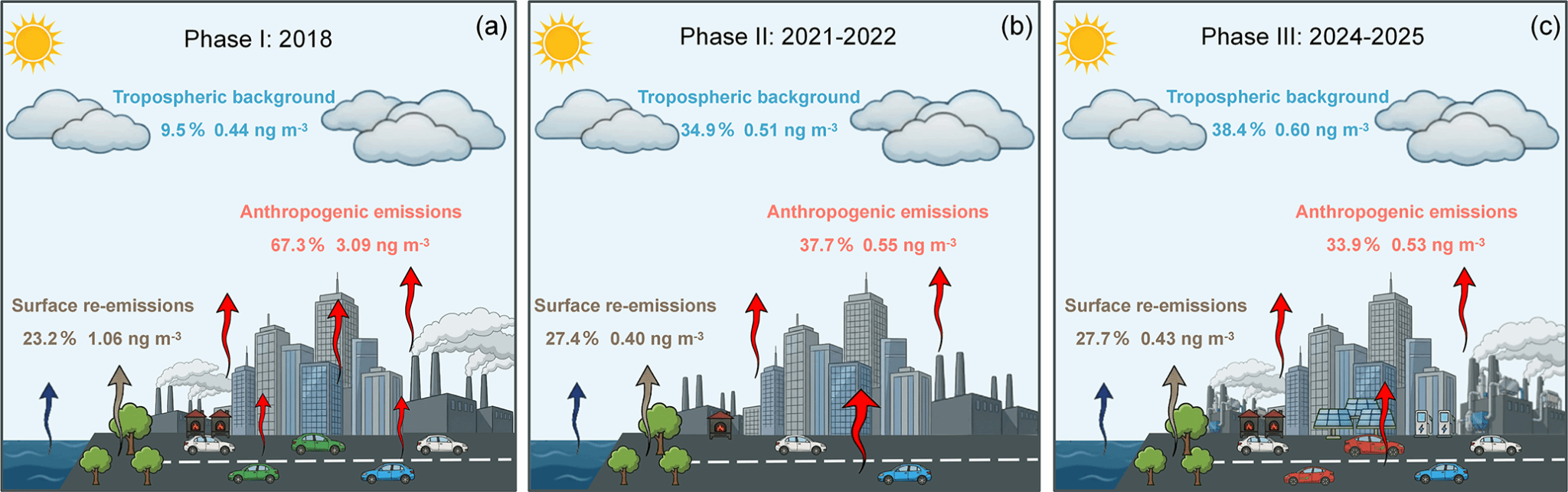
Figure 1. Source contributions to GEM concentrations during three research phases in Tianjin.
This study demonstrates that stable mercury isotopes can identify source changes behind declining atmospheric mercury concentrations and reveal surface re-emission and regional background control processes that are difficult to resolve using concentration observations alone. The findings provide important isotopic evidence for evaluating the effectiveness of the Minamata Convention and China’s atmospheric mercury emission reduction policies, and offer new scientific insights into urban mercury cycling in the post-emission-reduction era.
The study was published in Atmospheric Chemistry and Physics, a well-known journal in atmospheric science. Chao Zhang, a PhD student from the 2025 cohort at the School of Earth System Science, is the first author, and Professor Ruoyu Sun is the corresponding author. This research was supported by the National Natural Science Foundation of China under grants 42373011 and 42421003, and the Tianjin Science Fund for Distinguished Young Scholars under grant 23JCJQJC00280.
Article information: Chao Zhang, Xiaomiao Mu, Ruoyu Sun*, Songjing Li, Zhao Wang, Xinguang Li, Muhammad Asif Sherliyat, Xiaojian Wang, Yi Liu, Wang Zheng, and Jiubin Chen. 2026. Long-term mercury isotope evidence for a shift toward background-dominated urban atmospheric mercury in North China under sustained emission controls. Atmospheric Chemistry and Physics, 26(8), 5747–5761. https://doi.org/10.5194/acp-26-5747-2026.