Coastal regions account for less than 20% of the world’s land area, yet they are home to nearly half of the global population. Their high livability is a major reason why people are drawn to the coast, and the sea-land breeze plays an important role in maintaining that livability.
Driven by the temperature difference between land and sea, this local atmospheric circulation brings cool sea breezes inland during the day and carries hot, dry air back toward the ocean at night. It helps ease urban heat and improves air quality in cities.
However, global ocean warming is reshaping the temperature contrast between land and sea. How will sea-land breezes in coastal cities respond? Will cities in different climate zones show different patterns? And how closely are future warming levels linked to changes in sea-land breezes? Answering these questions is essential for assessing and predicting the future livability of coastal cities, as well as for supporting climate action and sustainable urban development.
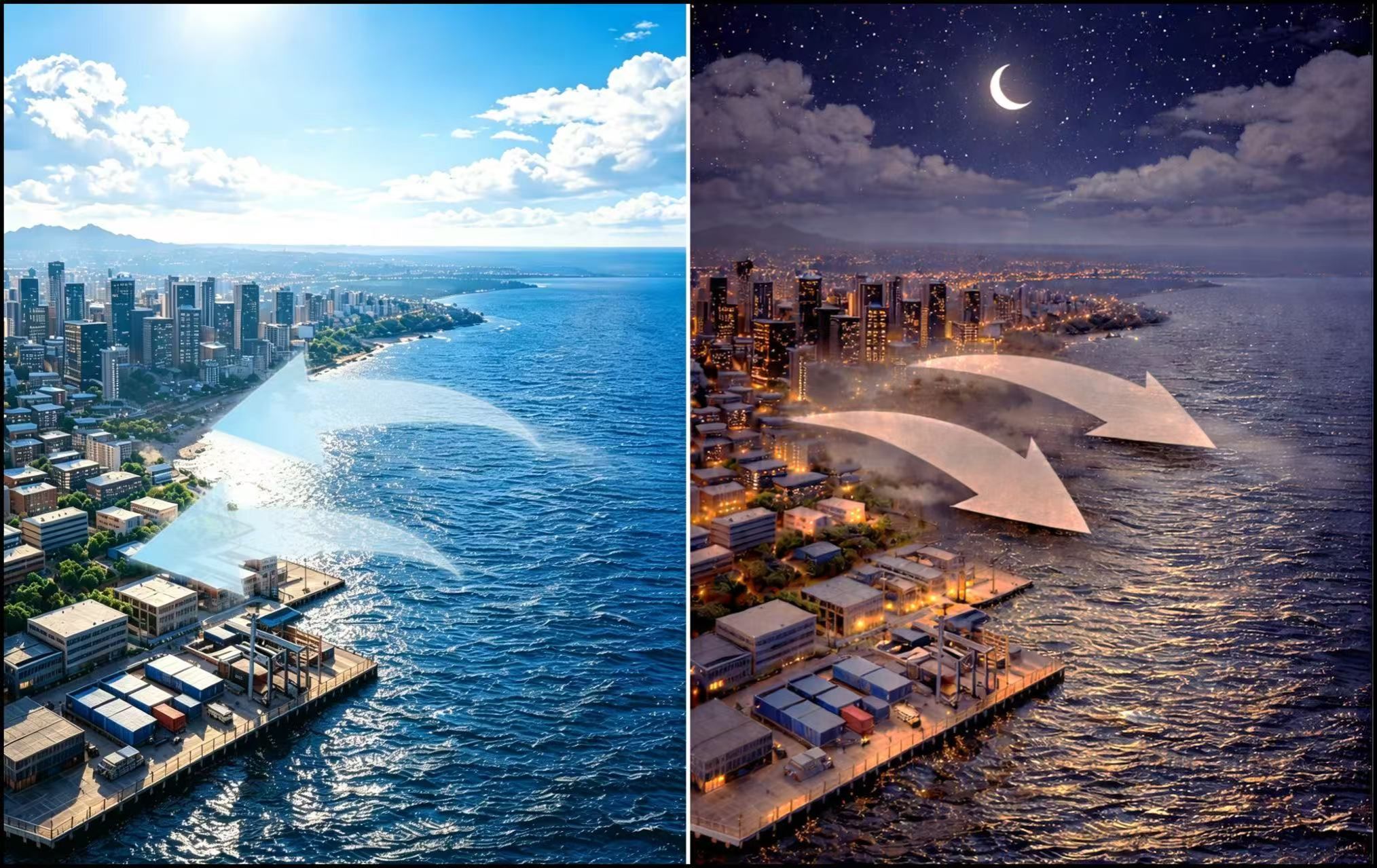
Figure 1. Schematic diagram of sea-land breeze circulation in coastal cities
On April 17, a research team led by Professor Jialei Zhu from the school of earth system science, Tianjin University published its latest findings in the leading international scientific journal Nature Climate Change. The paper is titled “Ocean Warming Weakens the Sea-Land Breeze in Coastal Megacities.”
This study is the first to systematically examine how the number of sea-land-breeze days has changed in 18 representative coastal megacities around the world under the influence of ocean warming. The research team improved a regional atmospheric model by introducing dynamic sea surface temperature inputs and developed a method for identifying sea–land breeze days.
Through a large number of sensitivity experiments and cross-validation using multiple data sources, the team revealed how coastal megacities in different climate zones respond differently to rising sea temperatures. The study also compared future trends under different emission scenarios. These findings show a new pathway through which global climate change can affect local living environments, expanding our understanding of how climate change may reshape the livability of cities at the regional scale.
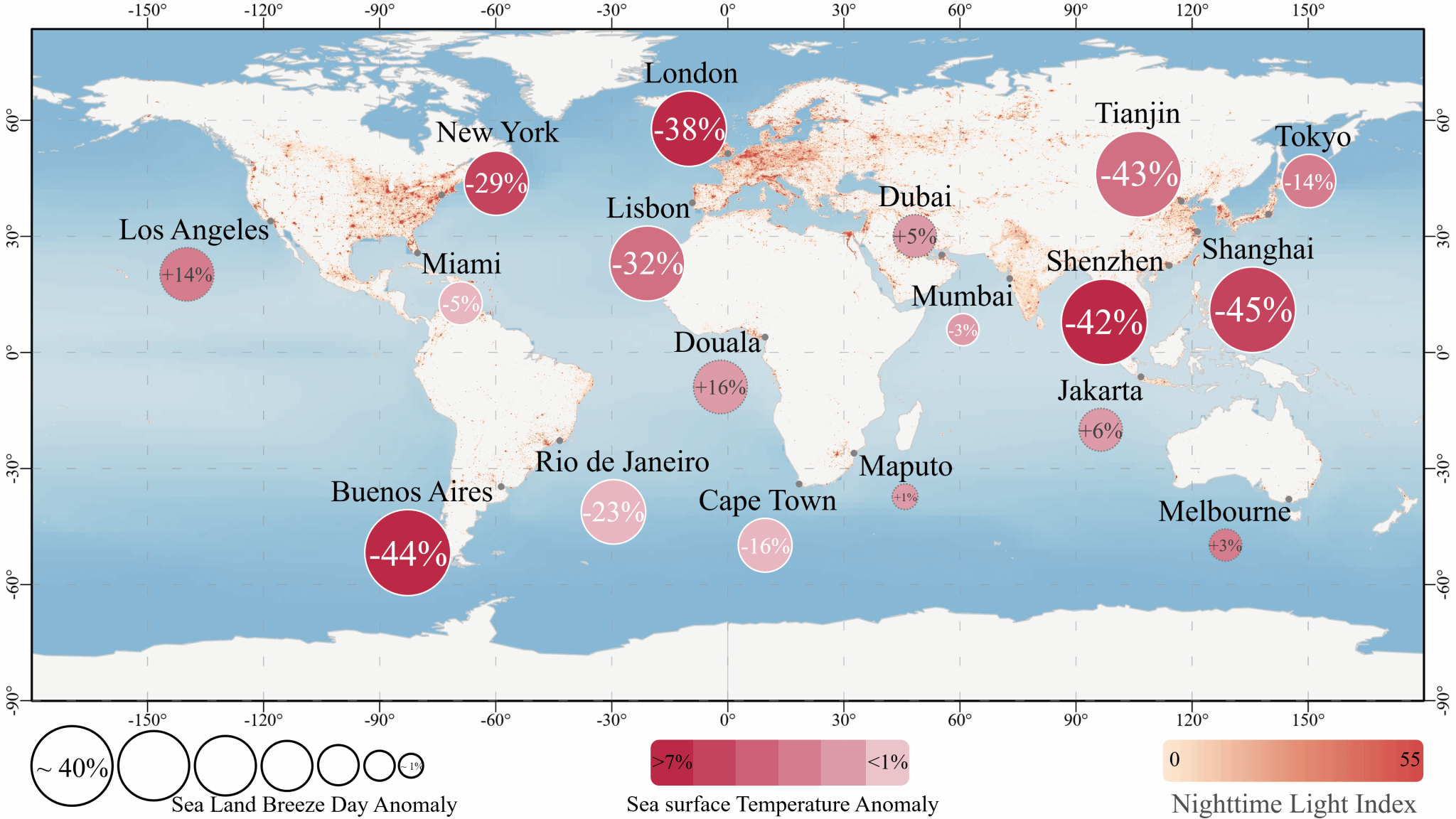
Figure 2. Response of sea-land breeze days in 18 representative coastal cities to historical sea surface temperature changes from 1970 to 2010
Over the past 40 years, rising sea temperatures have reduced the number of sea-land breeze days in two-thirds of the representative coastal cities studied, with decreases ranging from 3% to 45%.
Mid-latitude coastal megacities, such as New York, London, Shanghai and Lisbon, were found to be especially sensitive to ocean warming. The rate of ocean warming exceeded 5% in these spots, far higher than the rate of land warming. This path narrowed the temperature difference between land and sea, weakening the key thermal condition needed to trigger sea-land breeze circulation. The weakening effect was particularly strong in summer and fall.
Under the SSP5-8.5 (a faster-warming scenario), the average sea surface temperature is only about 0.4°C higher than under the SSP2-4.5 (a moderate-warming scenario). Yet in megacities located in high-impact areas, the decline in sea-land breeze days is 4.5 times greater than under the SSP2-4.5 scenario, with the average reduction increasing from 6% to 27%. This means that sea-land breezes respond to ocean warming in a highly non-linear way. Even a small increase in sea temperature can lead to a sharp decline. This study systematically reveals how ocean warming can weaken local thermal circulation and quietly undermine the natural ventilation and cooling capacity of coastal cities. These findings offer a new scientific perspective for assessing and predicting the vulnerability of coastal cities through directly linking global climate signals with livability risks in coastal areas.
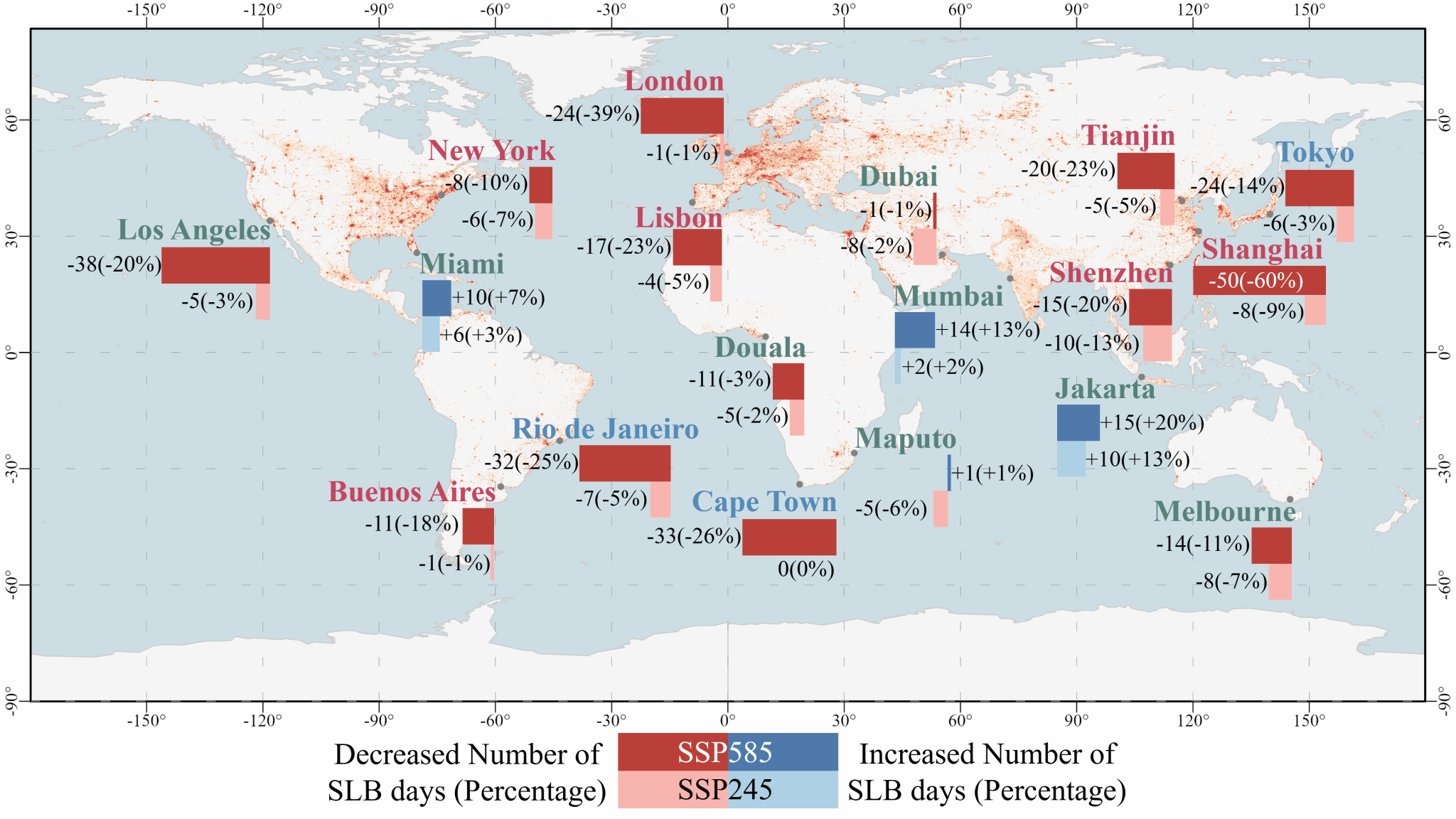
Figure 3. Future changes in sea-land breeze days in 18 representative coastal cities from 2010 to 2050 under different ocean warming scenarios. The darker upper section represents the SSP5-8.5 scenario, while the lighter lower section represents the SSP2-4.5 scenario.
This research was jointly conducted by Tianjin University, China Meteorological Administration and Tianjin Meteorological Bureau. Yunting Xiao, a doctoral student at the School of Earth System Science, Tianjin University, is the first author of the paper, and Professor Jialei Zhu is the corresponding author. The study was guided by Academician Cong-Qiang Liu and Professor Pingqing Fu of Tianjin University.
Other contributors include Research Fellow Yu Nie from the National Climate Center, Research Fellow Yongjie Fang from the Earth System Modeling and Prediction Center of the China Meteorological Administration, Research Fellow Jianbo Yang from the Tianjin Institute of Meteorological Science, and doctoral students Yaxin Liu, Hao Liu and Yan Dou from the research team.
This study is supported by the Natural Science Foundation of China (grant number 42221001).
Paper information:
Yunting Xiao, Yaxin Liu, Yu Nie, Yongjie Fang, Hao Liu, Yan Dou, Jianbo Yang, Cong-Qiang Liu, Pingqing Fu and Jialei Zhu*, 2026. “Ocean Warming Weakens the Sea-Land Breeze in Coastal Megacities.” Nature Climate Change. https://www.nature.com/articles/s41558-026-02618-9