Brown carbon (BrC) exhibits strong light absorption in the near-ultraviolet to visible spectral range, thereby influencing the Earth's radiation balance and regional climate. Due to the complexity of BrC and the wavelength dependence of its light absorption, the molecular absorption characteristics and wavelength-dependent mechanisms have remained a key topic in atmospheric chemistry and a prominent challenge in current BrC research.
Addressing the issues, Professor Yulin Qi's team employed chromatographic techniques to separate different light-absorbing fractions of BrC and systematically characterized their chemical composition and structural features. The results revealed that,
1) medium-polarity BrC exhibited the strongest light absorption in the 200–220 nm wavelength range, while low-polarity components became the dominant absorbers in the 220–450 nm range. The medium-polarity BrC exhibited the strongest carbonyl absorption peak (190–300 nm) in NMR spectra, as direct molecular-level evidence for the light absorption mechanism.
2) BrC absorption in the 200–220 nm band was dominated by carbonyl functional groups and aromatic compounds, whereas the primary light-absorbing components in the 220–450 nm band were aromatic amines, terpenoids, and heterocyclic compounds.
3) The ratio of UV-Vis absorption between 200–220 nm and 220–450 nm can be used for semi-qualitative inference of the main functional group types in BrC and their potential environmental effects.
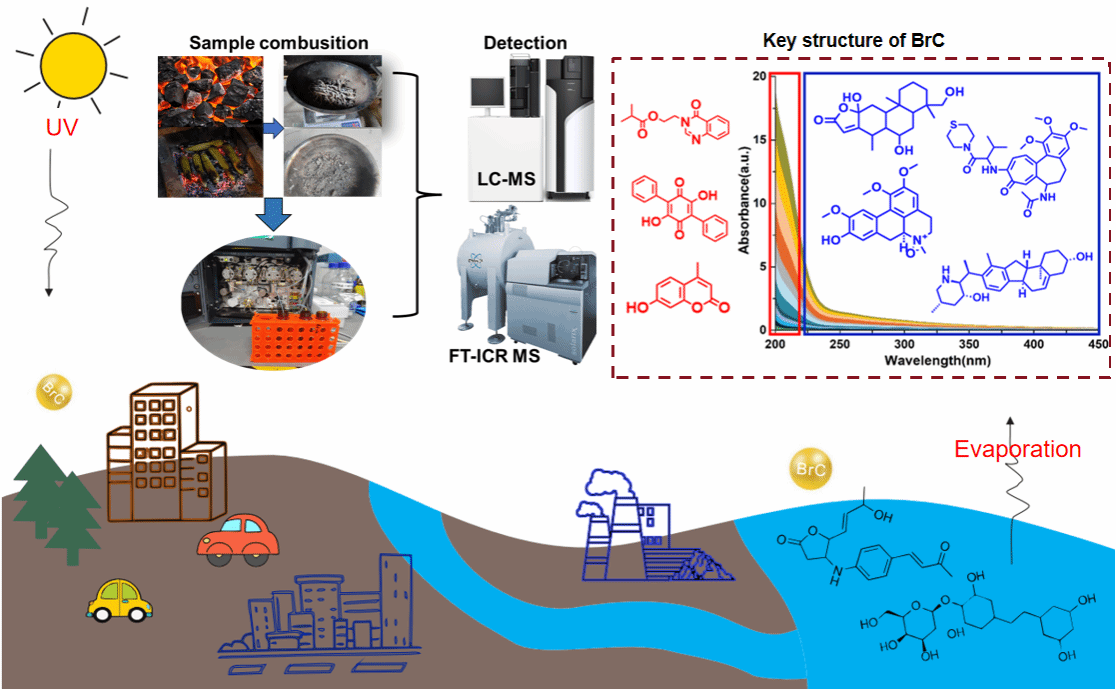
This study establishes a link between spectral signal and molecular structure, providing a new molecular-level perspective for understanding the structural characteristics of BrC but also offering scientific support for future rapid assessment of atmospheric absorption characteristics.
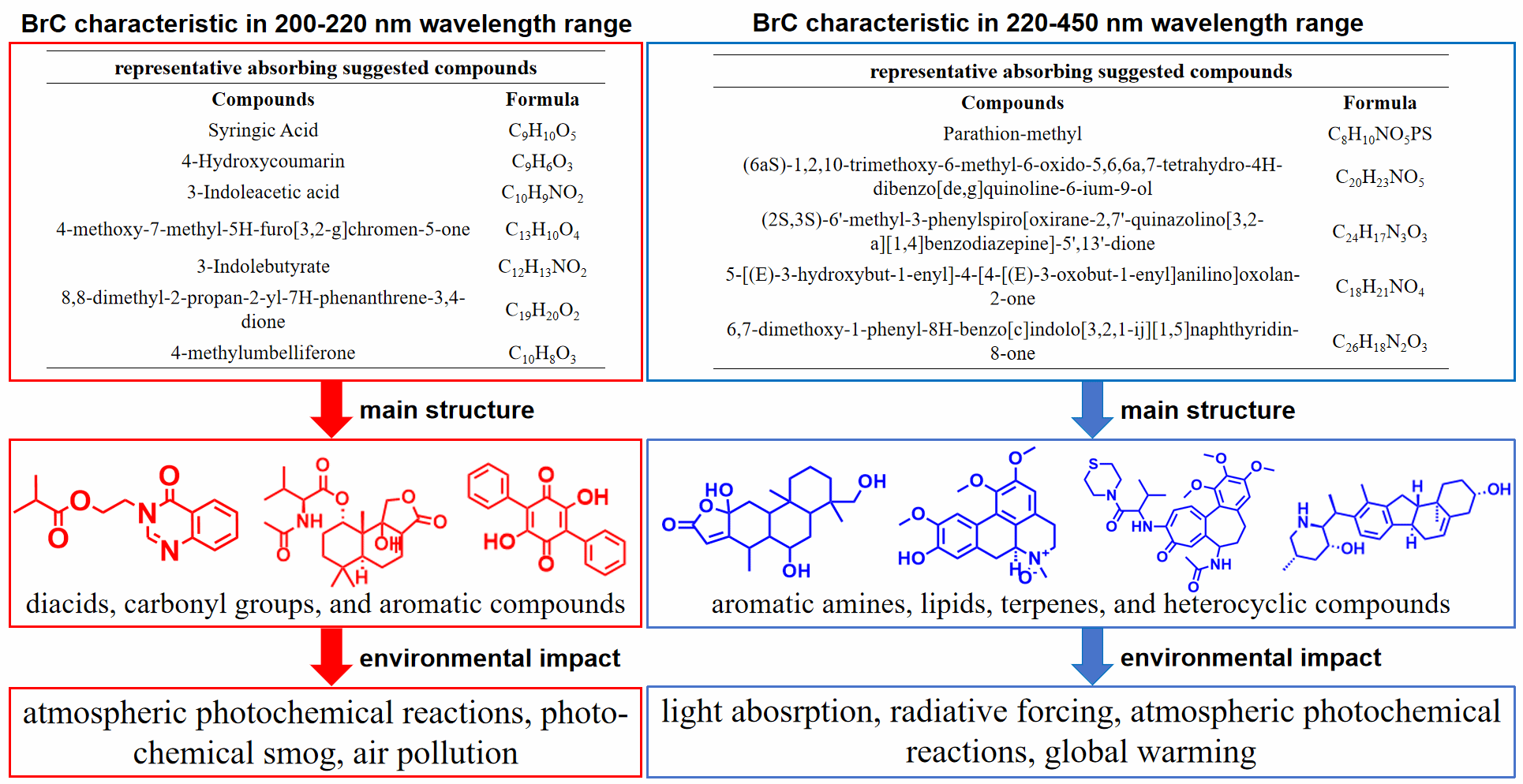
The related findings have been published in the Journal of Geophysical Research: Atmospheres, the first author is Wenrui Yao. Professors Pingqing Fu and Yulin Qi are co-corresponding authors.
Wenrui Yao, Yulin Qi1, Jinfeng Ge, Xiaoli Fu, Zhanjie Xu, Libin Wu,Wei Hu, Junjun Deng, Pingqing Fu (2025). Resolving the Ultraviolet-Visible Spectra for Brown Carbon: Insights into Structure-dependent Light Absorption Variations and its Potential Environmental Impacts. Journal of Geophysical Research: Atmospheres. DOI:10.1029/2025JD044402