In the traditional understanding of microbiology, minerals are either “food” (providing metal cofactors such as iron, manganese, and molybdenum, or serving as electron donors or acceptors) or “houses” (providing attachment surfaces and shelters). Those non-nutritive minerals that can neither be consumed nor participate in redox reactions—such as aluminum oxide (Al₂O₃) and silicon dioxide (SiO₂)—have long been regarded as silent “backdrop” in the microbial world.
A study led by Professor Teng (H. Henry Teng)’s team at the School of Earth System Science, Tianjin University, used the environmentally widespread Enterococcus faecalis as a model and applied transcriptome sequencing technology to reveal the “comprehensive reprogramming” of this bacterium by nano- to millimeter-scale Al₂O₃ and SiO₂ particles. The results were striking: mineral contact triggered significant differential expression of hundreds of genes, far beyond what simple physical attachment could explain.
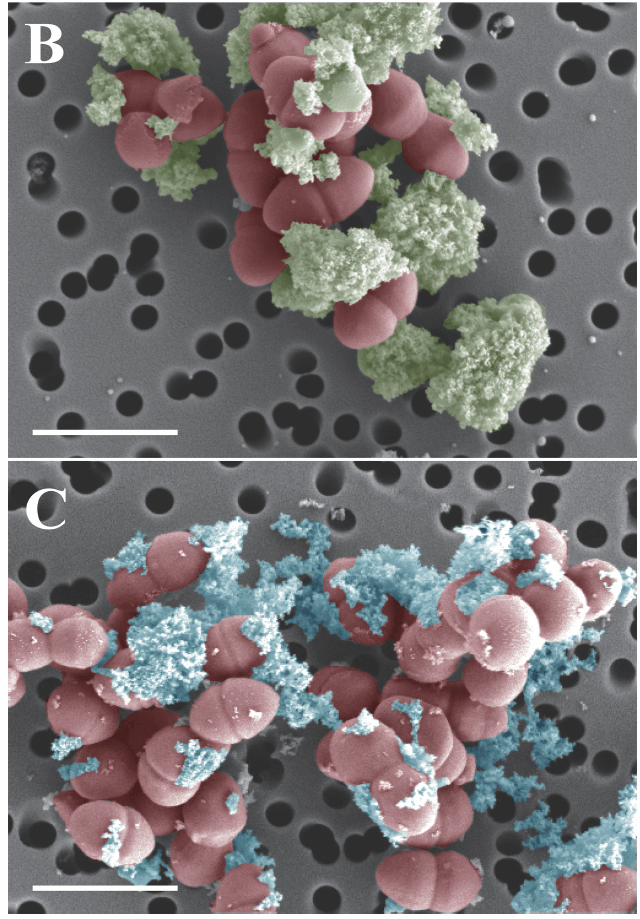
Image: Enterococcus faecalis cells closely contacting minerals and interacting with them.
The “Iron Paradox”: Not Iron-Deficient, Yet Forcing Bacteria into a Frenzied “Iron Grab”
Iron uptake genes were activated unusually strongly (expression upregulated nearly 20-fold), while antioxidant defense systems (such as catalase and thiol peroxidase) were also substantially upregulated in parallel. This was not because the bacteria were “iron-deficient”; rather, mineral particles adhering to the cell surface physically obstructed membrane protein transport and generated reactive oxygen species (ROS) through surface defects, creating oxidative stress. The bacteria misperceived this as “iron limitation” and launched an iron-scavenging program, while at the same time having to mount a full response to oxidative damage. Facing this dual predicament of perceived iron deficiency and oxidative toxicity, E. faecalis was forced to initiate a sophisticated survival strategy: it sharply suppressed serine catabolism (downregulated nearly 7-fold) and redirected nitrogen resources into the biosynthesis of glutathione (a key antioxidant), with genes for related enzymes upregulated more than 3.7-fold. Meanwhile, by enhancing the expression of lactate dehydrogenase and NADH oxidase, it cleverly maintained redox balance to support high-intensity detoxification.
“Size Sensing”: Nanoparticles Exert a Stronger Deterrent Effect
Bacteria do not treat all minerals “equally.” The study found that E. faecalis can finely distinguish mineral particle size through a “size-sensing axis” composed of the two-component regulatory system OmpR and the sigma factor SigV. Because of their enormous specific surface area and closer contact with the cell membrane, nanoscale particles elicited transcriptional responses far stronger than those to micrometer- or millimeter-scale particles. This “physical contact stress” is perceived by the cell membrane as a special type of envelope stress, which then initiates the corresponding defense program.
Unexpected Consequences: Collateral Enhancement of Antibiotic Resistance and Virulence
Mineral stress also upregulated virulence genes associated with adhesion (upregulated by 60%), invasion, and biofilm formation, as well as multiple antibiotic resistance genes. This means that in nanomineral-rich soils, sediments, and even medical environments, pathogenic bacteria may be “trained” to become more threatening and clinically recalcitrant without exposure to any antibiotics. The study provides a new perspective for understanding the functional evolution of soil microorganisms and elemental cycling, and sounds a warning for public health: ubiquitous mineral dust may be quietly becoming an “invisible driver” of the spread of microbial antibiotic resistance and virulence.
The findings were published in Applied and Environmental Microbiology. Luhan Li, a 2025 doctoral student at the School of Earth System Science, Tianjin University, is the first author. Professor Teng (H. Henry Teng) and Associate Professor Jianchao Zhang are co-corresponding authors. This work was funded by the National Natural Science Foundation of China (42421003, 42430205).
Paper information:
Luhan Li, Jianchao Zhang, Sumin Qu, Zhiying Zhou, Beibei Wang, Haitao Wu, Zilin Guo, Lin Shi, Bohao Yin, Xiangyu Zhu, Yuebo Wang, H. Henry Teng. The iron paradox and particle size sensing: transcriptomic response of Enterococcus faecalis to non-nutritive minerals. Applied and Environmental Microbiology. 2026. 00954-26.