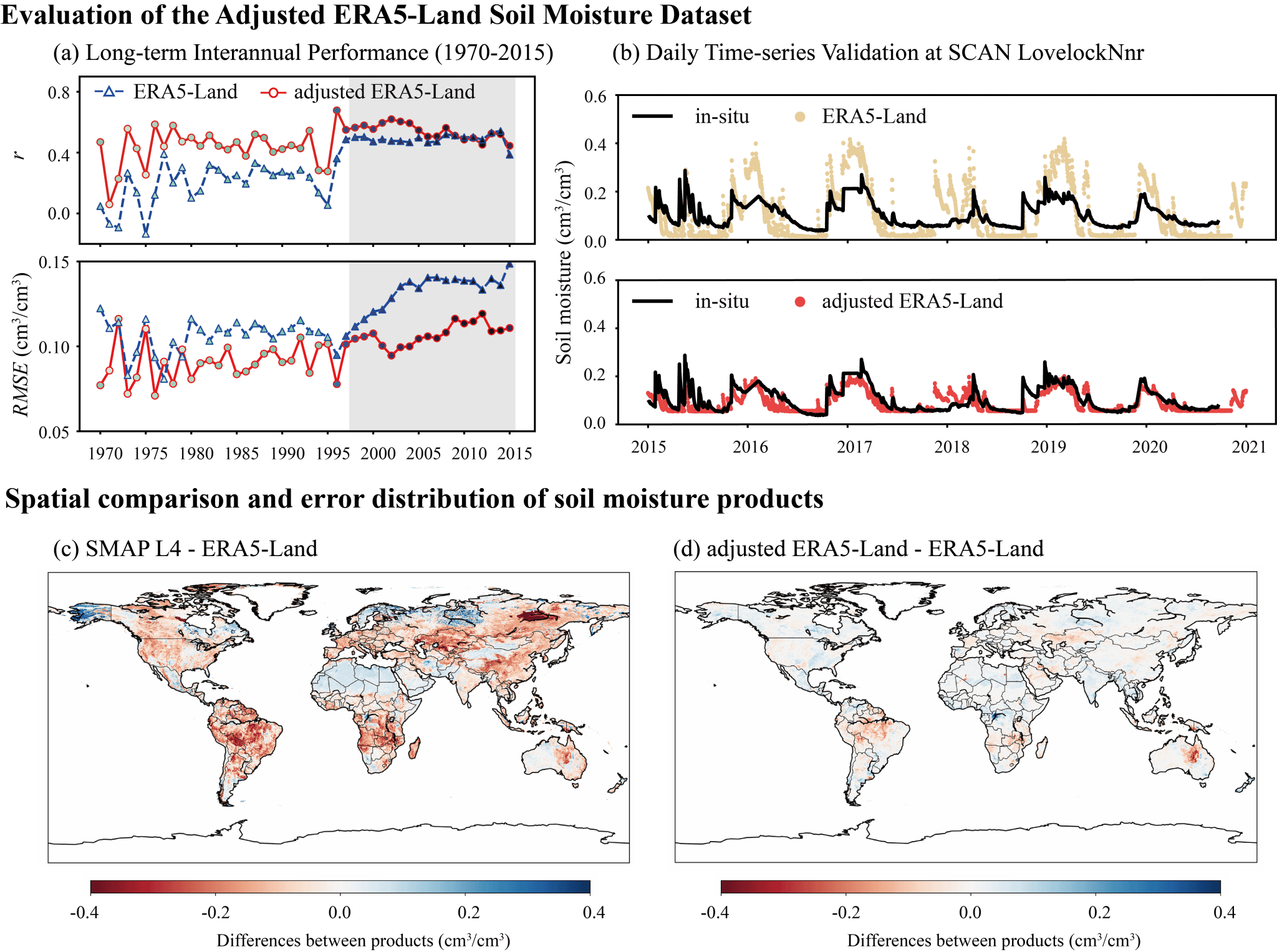
Accurate, high-resolution soil moisture data are critical for hydrological modeling, climate studies, and ecosystem management. Unfortunately, current existing global products suffer from inconsistencies, coverage gaps, and biases. Reanalysis datasets such as ERA5-Land exhibits high correlation but the data also shows significant bias, whereas satellite products such as SMAP L4 provides the highest accuracy but is limited by its temporal coverage.
Recently, the research group led by Associate Professor Yonggen Zhang at the School of Earth System Science, Tianjin University, published a study in the Top journal Earth System Science Data entitled “Fusing ERA5-Land and SMAP L4 for an Improved Global Soil Moisture Product (1950-2025)”. In this study, the team developed an Global Daily Soil Moisture Dataset at 0.1° Resolution (Adjusted ERA5-Land) soil moisture dataset spanning 1950 to 2025 by fusing ERA5-Land and SMAP L4. The resulting dataset substantially improves spatiotemporal coverage while effectively reducing systematic bias.
In this study, the researchers evaluated the surface layers of three widely used soil moisture products, including ERA5-Land, ESA-CCI (v09.1 Combined), and SMAP L4 with resolutions ranging from 0.1 to 0.25°, against in situ measurements across five networks, including ISMN, CMA, Cemaden, COSMOS-Europe, and SONTE-China. The compiled in situ database represents one of the most comprehensive global soil moisture collections to date, comprising approximately 3.8 million records, organized into a primary dataset for modern validation (2015-2020) and an independent historical dataset (1960-2015). It is found that during the primary validation period (2015-2020), ERA5-Land exhibits high correlation (with correlation coefficient of 0.69) between measured and predicted soil moisture but the data also shows significant bias. SMAP L4 provides the highest accuracy (with root mean square error (RMSE) value of 0.088 m3 m−3) and low bias, but is limited by its temporal coverage from 2015 to the present.
To address these gaps, the team applied a mean-variance rescaling approach using SMAP L4 as a reference to adjust ERA5-Land. This strategy effectively transfers the high accuracy of SMAP L4 to the long-term ERA5-Land time series while preserving its 75-year temporal coverage. Validation against the primary validation period demonstrates a reduction in RMSE of 24.6 % and an improvement in normalized Nash-Sutcliffe Efficiency (NNSE) of 30.6 % compared to the original ERA5-Land products. Crucially, the reliability of the backward extension was verified against independent historical observations spanning 1960 to 2015, demonstrating sustained improvements over ERA5-Land with 19.7 % RMSE reduction and 26.6 % NNSE increase.
The adjusted ERA5-Land dataset, which is publicly available, can be used as benchmark for future research and support drought monitoring, weather prediction, and water resource management, contributing to global climate resilience across diverse ecosystems. The dataset is provided for the surface layer with global coverage at a 0.1° spatial and daily temporal resolution, spanning from 1950 to 2025, at https://doi.org/10.57760/sciencedb.30546.
The study was first-authored by Wenhong Wang, a PhD student at Tianjin University. Co-authors include CAS Academician Cong-Qiang Liu, Professor Jianzhi Dong and Shiao Feng (Tianjin University), Professor Zhongwang Wei (Sun Yat-sen University), and Professors Lutz Weihermüller and Harry Vereecken (Forschungszentrum Jülich, Germany). The corresponding author is Associate Professor Yonggen Zhang (Tianjin University). This research has been supported by the National Natural Science Foundation of China (grant nos. 42472327, 42077168, and 42293260).
Citation: Wang, W., Feng, S., Zhang, Y.*, Wei, Z., Dong, J., Weihermüller, L., Liu, C.-Q., and Vereecken, H.: Fusing ERA5-Land and SMAP L4 for an improved global soil moisture product (1950–2025), Earth Syst. Sci. Data, 18, 1061–1088, https://doi.org/10.5194/essd-18-1061-2026, 2026.
Article link::https://essd.copernicus.org/articles/18/1061/2026/.