Mercury (Hg) is a persistent pollutant with global consequences, posing significant threats to both ecosystems and human health. The atmosphere serves as the main medium for the long-range transport of Hg and also acts as a vital bridge connecting the land, oceans, and cryosphere. It is within the atmosphere that Hg isotopes undergo fractionation, particularly non-mass dependent fractionation (MIF), making Hg-MIF one of the most promising indicators for tracing atmospheric processes, following oxygen- and sulfur-MIF. Recent studies indicate that atmospheric Hg isotopes not only help unravel the current and historical Hg cycles but also serve as a critical tool for assessing the impacts of future climate change on the Hg cycle and evaluating the effectiveness of Hg reduction policies. Under the global governance framework of the Minamata Convention on Hg, Hg isotopes offer a new method to distinguish the real effects of Hg reductions from changes in Hg concentrations caused by climate fluctuations and disturbances to legacy Hg stocks.
To address the current challenges in atmospheric Hg isotope research, Professor Sun Ruoyu’s team at Tianjin University’s Isotope Frontiers Science Research Center has published a comprehensive review (Figure 1). This study first summarizes the latest advancements in sampling techniques for atmospheric elemental Hg (GEM) and active Hg in particulate matter and precipitation, compiling a global dataset on atmospheric Hg isotopes from a variety of environmental settings, including background regions, urban-industrial areas, polar regions, and marine boundary layers. Based on this dataset, the study analyzes the key biogeochemical mechanisms driving atmospheric Hg mass-dependent fractionation (MDF) and non-mass-dependent fractionation (MIF), with a particular focus on the unique application of even-MIF as a tracer for atmospheric-land and atmospheric-ocean Hg cross-sphere transport.
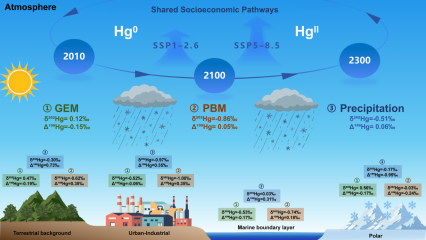
Figure 1. Graphical abstract
One of the core innovations of this research is the coupling of atmospheric Hg isotope simulations with future climate change scenarios (Figure 2). The study updates a one-dimensional atmospheric-land-ocean Hg isotope model based on Shared Socioeconomic Pathways (SSPs) to evaluate the long-term evolution of atmospheric Hg isotopes under different SSP scenarios. The results show that under a low-emission scenario characterized by green transformation (SSP1–2.6), the values of atmospheric Hg MDF (δ202Hg) and odd-MIF (Δ199Hg) exhibit a more significant upward trend over time compared to high-emission scenarios (SSP5–8.5). This evolution suggests a fundamental shift in the mechanisms driving the future atmospheric Hg cycle. As direct anthropogenic emissions (MIF≈0‰) decrease, legacy Hg (re-released from soils and oceans) with strong isotopic signals will increasingly dominate the atmospheric Hg budget, shaping the future trajectory of Hg isotopes in the atmosphere.
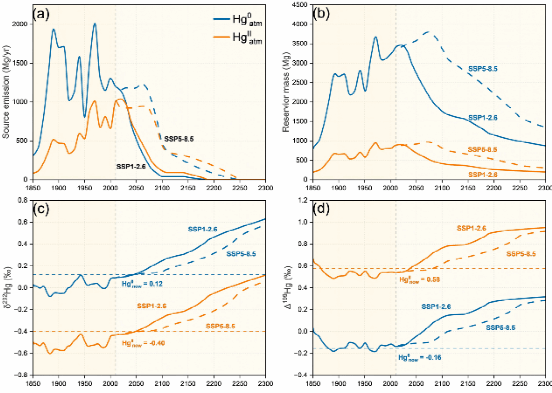
Figure 2. Future evolution trends of atmospheric Hg isotopic composition under SSP1–2.6 and SSP5–8.5 scenarios
Focusing on the evolution and tracing of atmospheric Hg isotopes in future climate change scenarios, the paper suggests expanding long-term observations in key regions, enhancing multi-medium isotope constraints, and deepening the integration of modeling and observations. These directions provide a scientific framework for applying Hg isotopes in atmospheric science research and policy assessment.
The study titled "Atmospheric Hg Stable Isotopes: Advances in Hg Cycle Tracing and Projections of Future Trends" has been published in the prestigious Earth-Science Reviews journal. The first author, Zhang Chao, is a PhD student at the School of Earth System Science, Tianjin University, set to graduate in 2025. The corresponding author is Professor Sun Ruoyu. The research was funded by the Natural Science Foundation of China (42421003, 42373011, 42173011) and the Tianjin Natural Science Foundation (23JCJQJC00280).
Article Information:Chao Zhang, Ruoyu Sun*. Atmospheric mercury stable isotopes: Advances in mercury cycle tracing and projections of future trends. Earth Sci. Rev., 272, 105348. https://doi.org/10.1016/j.earscirev.2025.105348